Slide

Patient Journeys

Slide

Patient Journeys

GET TO KNOW SOPHIA

Sophia was in high school when she first started experiencing trouble with her hand. At first, her symptoms were thought to be related to carpal or cubital tunnel syndrome. Over time, and after more evaluation, she was diagnosed and treated for Thoracic Outlet Syndrome (TOS) (see more information below).

In her story, Sophia shares what she has learned throughout this journey: how her peripheral nerve problem has affected her daily life, how she eventually found the right care team, her experience working with occupational and physical therapists, and advice for others going through their own nerve care journey.

IMPACT ON YOUR LIFE

Peripheral nerve problems—such as compression, transection, or stretching—can lead to muscle weakness, loss of muscle (atrophy), tingling, and pain. These issues occur when nerves are unable to properly send signals to their target muscles or areas of skin. As Sophia describes, these symptoms can have a major impact on school, work, daily activities, and overall quality of life.

Learn more about peripheral nerves and injuries.

ABOUT THE BRACHIAL PLEXUS

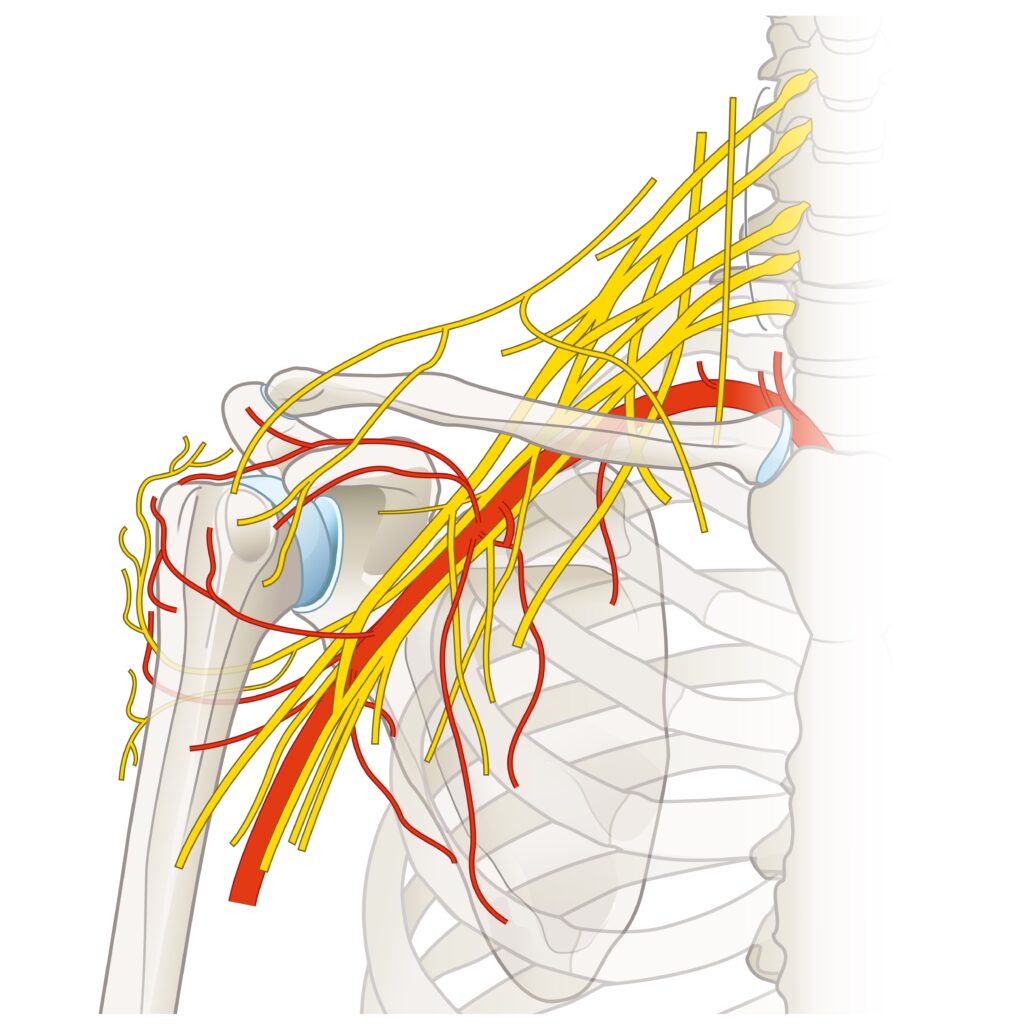
The brachial plexus is a large bundle of nerves that comes from the spinal cord in the neck (levels C5–T1, in yellow at left). These nerves travel between muscles in the neck, over the first rib, and under the collarbone before reaching the armpit, where they branch into the main nerves of the arm and hand (like the median, ulnar, and radial nerves). Because this nerve bundle runs through several tight spaces, it can be easily squeezed or irritated.

Thoracic outlet syndrome (TOS) happens when the nerves of the brachial plexus, and sometimes nearby blood vessels, are compressed as they pass through the thoracic outlet—the space between the neck and upper chest. In the most common type, called neurogenic TOS, pressure on the brachial plexus causes pain, tingling, numbness, or weakness in the shoulder, arm, or hand, especially when the arm is raised or used overhead for a long time. Knowing the path and structure of the brachial plexus helps doctors figure out if symptoms are due to TOS or another nerve problem and decide on the best treatment.

Finding care

Sophia was fortunate to receive a referral from her initial surgeon to a peripheral nerve specialist. But for many patients, finding care is not easy. Peripheral nerve care is fragmented across multiple specialties, including orthopedic surgery, plastic surgery, neurosurgery, occupational therapy, physical therapy, and more. Because of this fragmentation, patients often see many different specialists and may wait years before receiving a clear diagnosis and appropriate treatment.
The Global Nerve Foundation (GNF) is working to change this by building a directory of peripheral nerve specialists and a referral network that physicians can use to connect patients to expert care sooner—helping to shorten time to diagnosis and improve outcomes.   Visit the GNF Directory

WORKING WITH OTs and PTs

While surgery plays a significant role for some nerve conditions, occupational therapists (OTs) and physical therapists (PTs) are crucial partners in recovery. Sophia describes how she worked with therapists both before and after surgery to improve her strength, function, and overall use of her arm.

ADVICE TO OTHERS

Peripheral nerve care can be a long and difficult journey—physically, mentally, and emotionally. Sophia offers her thoughts and encouragement to others going through a similar experience, emphasizing the importance of:
• Finding a specialist who understands peripheral nerve problems.
• Staying positive and hopeful throughout the process

Thank you for sharing your story with us, Sophia.

Thank you for visiting the Global Nerve Foundation! Please Click below to joining our mailing list to stay informed!